Ethical principles form the foundation of the Fair Trade, and when discussing these principles in practice we are really talking about the way business should be conducted around the world on a day-to-day basis, placing people and planet above profit and private gains. The principles are not a political ideology, but sensible, humane and logical aspirations for living on a shared planet.
 Carola
WFTO © 2011
In the last series, "From Principles to Practices", I focused on the importance of breaking down principles to an everyday occurrence. Coincidentally on June 20th, I received a weekly newsletter from Carola Reintjes, Chief Executive of the World Fair Trade Organization. In this newsletter she presented a terrific idea for promoting Fair Trade principles. With the permission of WFTO, I have reprinted that newsletter here:

Dear members, dear FAIR traders,
Shalom, Jambo, Dobar dan, Bula Wantok, Buenos días, Good day, Ciao, Bom dia, Nihao, Asalamou Aleikoum, Bonjour, Mabuhay, Konnichi wa, Namaste!
Today I would like to share with you a very simple proposal. I strongly believe in the simple and small things in life. Simple things and small gestures can have high impact, and can potentially change lives.
If a journalist asked you what it is that makes you different from other business, some of you might tell a long story, others might just say “We are fair traders”. But when this journalist keeps on insisting (surely a habit which characterizes all journalists around the globe), and asks what makes a Fair Trade Organization different from conventional companies, our answers will be very similar. We might not use the same words, we might express in multiple forms, but we will try to tell the journalist that our business is based on values. Some of us might mention our Fair Trade principles. The journalist will feel our pride when we explain to him/her our value-based approach to production and trade.
At the Mombasa AGM we approved our new WFTO Fair Trade System for membership, monitoring and certification which has at its core our 10 principles. We slightly changed the wording of our principles and incorporated the cultural identity into one of our principles.
We would like to challenge you around our 10 principles. Can you imagine yourself, your colleagues, all employees, workers and producers knowing our principles? Just imagine! It would be very powerful.
Just imagine a visitor coming to see you, a buyer, a consultant, or an auditor. Imagine whomever he/she asks about your values, about the principles, and about how you incorporate these principles into your daily work, there will not be 50 different answers but only one common answer: a clear reference to our principles, and a clear explanation on how you work with these principles, how your organizations embeds them into your daily work.

Now my simple proposal:
- Print our Fair Trade principles;
- Make sure you only use the recent version approved at the Mombasa AGM;
- (Download) the document in English (see below) and Spanish (see at bottom);
- Eliminate all previous versions from your files, only use this last version;
- Distribute copies to your colleagues, employees, workers and producers;
- Hang them on your wall at your work-place (desk, table, wall, …);
- Assure everybody does the same;
- Try to organize a short session every week, or ask for it to be organized;
- During the session discuss collectively one of the principles (one every week);
- In ten weeks your staff, workers and producers will have gone through a wonderful training on the 10 principles;
- Tell us about your sessions, tell us about your good experience, but as well about the problems you come across when implementing the principles;
- Take photos during the sessions, film your sessions;
- Share your experience, photos, film, drawings, with us;
- We would like to share your good experience with other members, we will tell your story to motivate others.
This simple proposal is meant for all of us, producer organizations and marketing organizations, manufacturers and traders, exporters and importers, wholesalers and retailers. Don’t just assume that in your organization people are well trained on our principles, just because your organization has been in Fair Trade business for 20 or 30 years.
You might need to translate the principles into your local language/s.
You might need to convert them into graphics, drawings.
We surely cannot make the mistake to be exclusive around our values.
All of our employees, workers and producers have a right to clearly understand what they are working for. Many hours of their live will be dedicated to Fair Trade, so we better make sure we reach out to all the people we are responsible for.
All of our employees, workers and producers have a right to clearly understand what they are working for. Many hours of their live will be dedicated to Fair Trade, so we better make sure we reach out to all the people we are responsible for.
Our Fair Trade principles are our family silver. They make us unique in a highly competitive and exploitative world out there. Let us make sure we dedicate the attention our values deserve, and let us make sure each of the persons we are responsible for in our organization clearly understands and implements each of the principles.
We wish you a GOOD week, and an interesting first session,
On behalf of the Secretariat,
WFTO © 2011
WFTO 10 Fair Trade Principles June2011-2
I like this idea because Carola's proposal is practical. It requires no costly effort and is essential to the sustainability of the Fair Trade Movement. More importantly, this activity needs to be done by organizations throughout the supply chain! There are many creative ways to make this a fun interactive and memorable activity. The best way to transfer ownership of these principles is through providing opportunities for staff and workers to teach others!
Most producer groups Chou and I met with on this journey had some degree of knowledge of the Fair Trade principles. Admittedly, there was room for improvement for some and an activity such as Carola suggests will definitely improve the situation. When principles are not shared with producers and key people within a Fair Trade Organization it can have disastrous results. In Cambodia, we witnessed how Fair Trade can fail those it is intended to benefit when the principles of Fair Trade were not integrated into the day-to-day operations and were not passed on to empower the craftswomen and men. Admittedly, it was the most challenging post to write because it was contrary to the results I had hoped to publish.
In that blog post I asked myself, "What do I do when I go to listen to the voices of Fair Trade, but the voices are absent? By absent, it is not that they are missing as in people do not want to share their views on what Fair Trade means to them... I found myself asking, what happens when, for no fault of their own, the very people who you go to listen to, don’t have an answer because they don’t know what you are asking?" For insight to the personal and organizational effects of disregarding the principles, you can read the blog post:
However, the practice of our shared principles is not for producers alone! I can name at least one American certified Fair Trade importer who could really use Carola's activity (Read: Coffee Part II - "It's not my Problem"), and from what I have heard, it sounds like the problem is more wide spread than we would like to admit.

Since starting this blog, I occasionally receive emails from people who plan to take similar journeys related to Fair Trade. Sometimes they are socially conscious backpackers, other times they may have something they wish to contribute to the Fair Trade movement and feel that a journey to meet producers is a good approach. Recently, I received an email from a Fair Trade / Environmental Activist in Spain. He shared his plan to conduct a journey of his own to follow-up on Fair Trade. However, as an advocate he expressed a sincere concern regarding the Fair Trade Movement in Spain that should be ringing alarm bells for all of us. With his permission, I reprint part of his email here:
I like this idea because Carola's proposal is practical. It requires no costly effort and is essential to the sustainability of the Fair Trade Movement. More importantly, this activity needs to be done by organizations throughout the supply chain! There are many creative ways to make this a fun interactive and memorable activity. The best way to transfer ownership of these principles is through providing opportunities for staff and workers to teach others!
 |
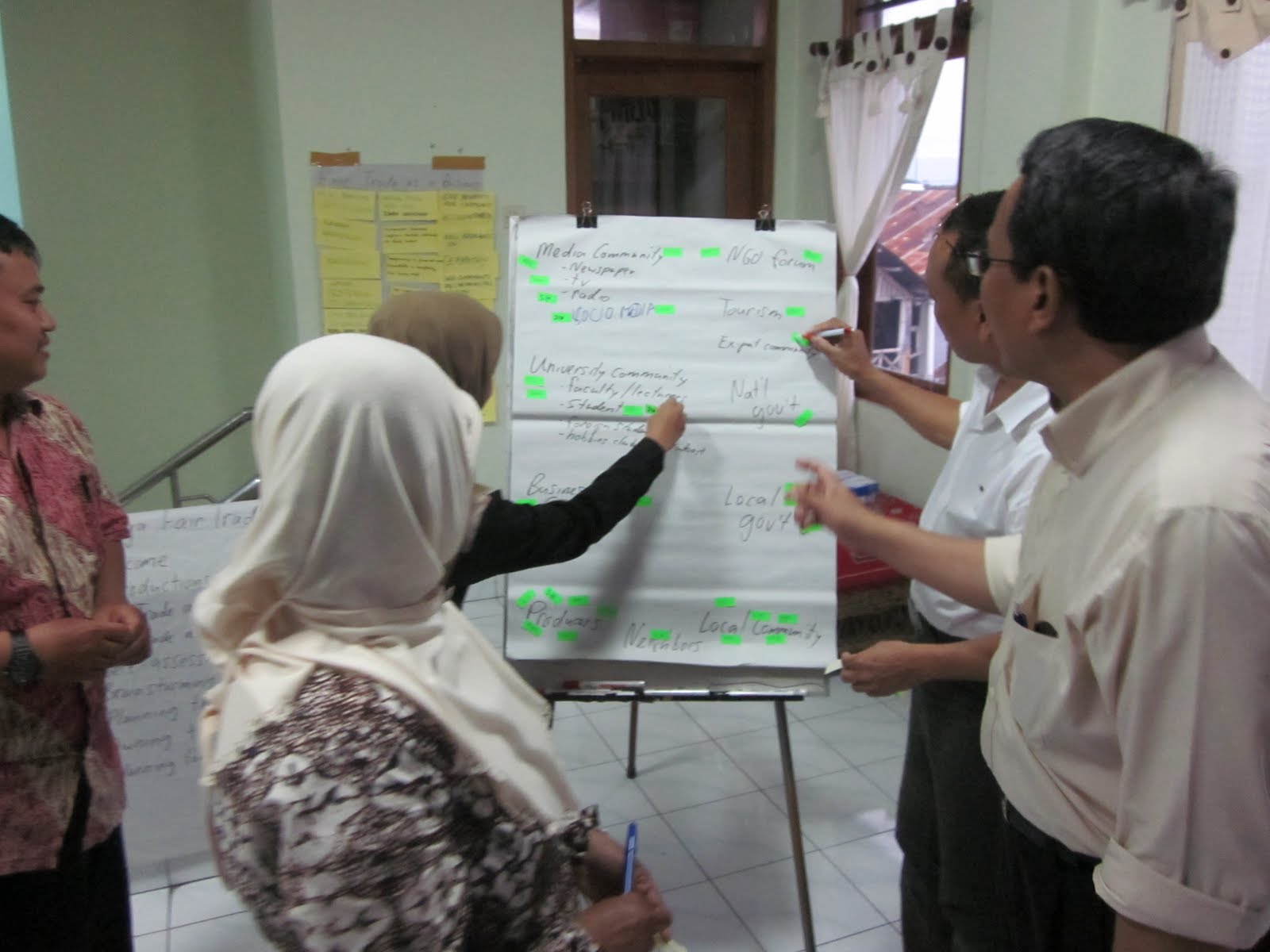
| The Principles of Fair Trade in Bahasa Indonesia, at the workshop of a Mitra Bali silversmith |
Most producer groups Chou and I met with on this journey had some degree of knowledge of the Fair Trade principles. Admittedly, there was room for improvement for some and an activity such as Carola suggests will definitely improve the situation. When principles are not shared with producers and key people within a Fair Trade Organization it can have disastrous results. In Cambodia, we witnessed how Fair Trade can fail those it is intended to benefit when the principles of Fair Trade were not integrated into the day-to-day operations and were not passed on to empower the craftswomen and men. Admittedly, it was the most challenging post to write because it was contrary to the results I had hoped to publish.
In that blog post I asked myself, "What do I do when I go to listen to the voices of Fair Trade, but the voices are absent? By absent, it is not that they are missing as in people do not want to share their views on what Fair Trade means to them... I found myself asking, what happens when, for no fault of their own, the very people who you go to listen to, don’t have an answer because they don’t know what you are asking?" For insight to the personal and organizational effects of disregarding the principles, you can read the blog post:
However, the practice of our shared principles is not for producers alone! I can name at least one American certified Fair Trade importer who could really use Carola's activity (Read: Coffee Part II - "It's not my Problem"), and from what I have heard, it sounds like the problem is more wide spread than we would like to admit.

Since starting this blog, I occasionally receive emails from people who plan to take similar journeys related to Fair Trade. Sometimes they are socially conscious backpackers, other times they may have something they wish to contribute to the Fair Trade movement and feel that a journey to meet producers is a good approach. Recently, I received an email from a Fair Trade / Environmental Activist in Spain. He shared his plan to conduct a journey of his own to follow-up on Fair Trade. However, as an advocate he expressed a sincere concern regarding the Fair Trade Movement in Spain that should be ringing alarm bells for all of us. With his permission, I reprint part of his email here:
Hi Mitch,
I've just landed to your blog and I must sincerely congratulate for all your work and investigation in favor of fair trade. I work as environmentalist for Friends of the Earth - Spain, at the same time I'm involved in various non-prof fair trade, social and wildlife groups that keep myself happily busy and always on guard to fight for human and nature rights!!!
After many years involved in fair trade, social issues and environmental protection, I've decided to take a some time off to travel Asia and South America with the aim to visit communities and see if fair trade is really working as a catalyst for social and economic change and to value if we are all working towards building a sustainable future for both humans and nature.
After many years involved in fair trade, social issues and environmental protection, I've decided to take a some time off to travel Asia and South America with the aim to visit communities and see if fair trade is really working as a catalyst for social and economic change and to value if we are all working towards building a sustainable future for both humans and nature.
I must say that there is a lack of transparency in FT issues in Spain, all shops buy direct from importers but there is a few information from importers on the real impact on communities: working conditions, families, health, education, rights,...everyone seems to be pretty happy just buying FT goods and no-one ask any further questions. To this point there are quite a few voices raising to demand more information and a real reports and analysis on FT impact on communities....but no-one seems to hear our demands.
In order to solve this lack of transparency and impact issue I've decided to travel to Asia and Latin-América to see things for myself. This journey will keep me on the move for at least two years. If everything works OK I hope to spend a year in Asia and the rest in Latin-América...
Warmest regards from Spain and all the best with your project, you are carrying out a fantastic work !!!
I am encouraged by his personal commitment to follow-up on the impacts of Fair Trade. However, he also brings up a serious issue that directly relates to the importance of knowing the Fair Trade Principles regardless of where you find yourself in the supply chain. As an importer, retailer, consumer or advocate, how can we promote Fair Trade if we don't share the direct impacts of Fair Trade principles in a community?

One of the main motivating factors for Chou and I to embark on this journey was to learn about and present the impact of Fair Trade on producers. I have been in many Fair Trade shops and I am often disappointed that the only information about the producers is on a small sales tag. Surely Fair Trade retailers can provide more information than that!
There are many ways to bridge the existing gap between producers and consumers. Here are a few examples that I have seen:
- Provide handouts or brochures that offer links to producer websites.
- Feature a simple one-page summary of a producer group each month with a couple photos.
- Offer opportunities to travel to meet producer groups in near-by locations, or for the adventurous offer Fair Trade travel packages to foreign countries - I recently reviewed a brochure for Fair Trade tourism in Cebu, Philippines! Use the trip to take photos and get their stories to share in the store when you return!
- Bring Fair Trade producers to connect directly with customers for a special occasion or fundraising event.
If the principles are understood throughout the supply chain, the information regarding the impact of Fair Trade is more readily shared! In many cases Fair Trade producers have websites and it is possible to see the impacts of Fair Trade through the information they provide. In other cases producers may not have access to the internet. In either case, the onus of responsibility for providing such information is on the importers and retailers alike.
As Carola wrote, "We surely cannot make the mistake to be exclusive around our values." Find out how those principles are making a difference and share your findings!

Thank you for following our blog. Chou and I welcome your comments, ideas and suggestions as we delve into the multitude of issues surrounding Fair Trade.
To be charitable is a virtue;
to be empowered is a human right.
Fair Trade empowers the disadvantaged, integrates the marginalized, and supports the impoverished with viable livelihoods. Click here to donate to the Fair Trade.
Mitch Teberg, MA